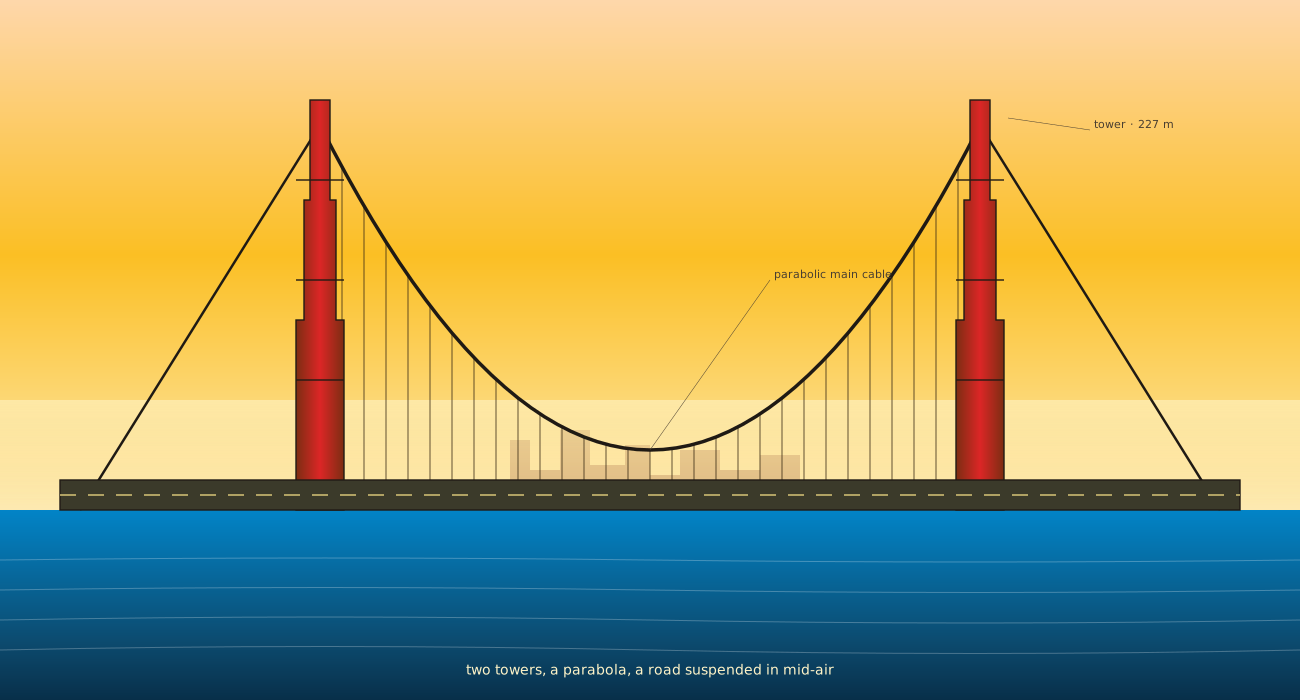
Gravity solved. You asked Claude. Glyph drew it — from a compose spec. Two towers, a parabolic cable, hundreds of vertical suspenders, and a road floating in mid-air.
"Draw me a suspension bridge — Golden Gate style. Two red art-deco towers, a single parabolic main cable, vertical suspenders dropping to a deck, anchors on each side, deep water below, soft sky above."
— what to say to your AI agent. Claude writes the Glyph compose spec; the compose compiler emits one byte-locked SVG.
RFC #9's defs (gradients + patterns), shapes (silhouette-path, polygon, polyline, ellipse), and accents (glow, starfield, icon) compose the whole picture.
The main cable is one silhouette-path — 41 sampled points along y = min - dip × (1 - 4(t-0.5)²), the parabola you get when a uniform horizontal load hangs from a flexible cable.
Vertical cables connecting the main parabola to the deck — each one a 2-point polyline at the sampled cable position. Their length grows toward the center where the cable dips lowest.
Each tower is a tapered trapezoidal d-string filled with a 3-stop linear gradient (the art-deco red). Cross-braces are polylines that get longer as they descend. The deck is a single rect; the centerline is a dashed polyline.
Claude writes the compose JSON; Glyph's compose compiler turns it into byte-identical SVG.
{
  "compose": {
    "viewBox": { "width": 1200, "height": 600 },
    "theme": { "preset": "pencil-parchment" },
    "defs": {
      "gradients": [
        { "id": "g-tower", "kind": "linear",
          "x1": "0%", "y1": "0%", "x2": "100%", "y2": "0%",
          "stops": [
            { "offset": "0%",  "color": "#7c2d12" },
            { "offset": "50%", "color": "#dc2626" },
            { "offset": "100%","color": "#7c2d12" }
          ]
        }
        // ... g-sky, g-water
      ]
    },
    "children": [
      // 1. sky gradient rect
      // 2. water gradient rect
      // 3. side cable left (anchor → tower top)
      // 4. side cable right
      // 5. 17 vertical suspender polylines
      // 6. main parabolic cable (40-sample silhouette)
      // 7. 2 tower silhouette-paths (gradient fill)
      // 8. 8 tower cross-brace polylines
      // 9. deck silhouette + dashed centerline
      // 10. 2 annotation-leaders (cable, tower)
      // 11. caption text
    ]
  }
}
Generator script: scripts/gen-showcase-extensions.mjs · fixture: packages/core/__fixtures__/compose/eng-bridge.json. View on GitHub.
Byte-stable across Ubuntu / macOS / Windows × Node 20 / 22. The compose compiler resolves the gradient + pattern defs first, then walks children in z-order.