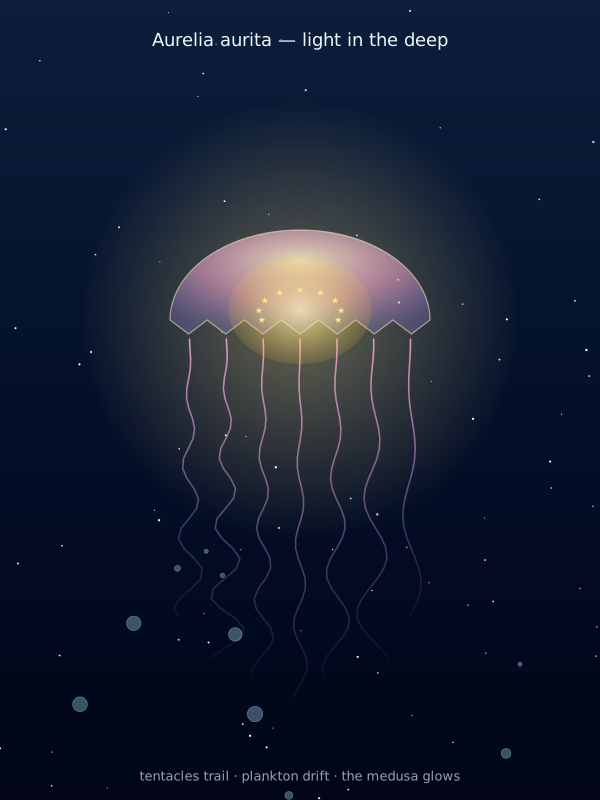
A moon jellyfish drifting through midnight water, drawn from one English sentence. You asked Claude. Glyph drew it — from a compose spec, no hand-tweaked SVG. Translucent bell, sine-modulated tentacles, bioluminescent dots that glow inside the medusa.
"Draw me a jellyfish in the deep. Translucent bell on top, tentacles trailing down in soft sine curves, a warm halo around the bell because real moon jellies bioluminesce. Plankton drifting around. Deep-ocean dark gradient — no horizon, no surface, just the medusa and the dark."
— what to say to your AI agent. Claude writes the Glyph compose spec; the compose compiler emits gradients, glow, ellipse, polyline, and silhouette paths into one byte-locked SVG.
Compose grammar handles the whole anatomy: bell, body, tentacles, halo, plankton — each one a different RFC #9 primitive.
The bell is a single d-string: a semicircular dome on top, then a scalloped V-V-V bottom. Seven tentacles below — each one a sampled sine with amplitude scaled by depth so they fade to nothing at the tips.
A radial-gradient halo behind the bell fades from warm yellow to transparent. Nine star icons placed in a half-ring inside the bell — these are the bright cells real moon jellies use to attract zooplankton.
80 dots placed deterministically by a seeded LCG — they read as plankton in the dark. A linear-gradient rect behind everything provides the deep-ocean blue-to-black backdrop.
Claude writes the compose JSON; Glyph's compose compiler turns it into byte-identical SVG. Try the same seed on Linux, macOS, Windows — the plankton land in exactly the same places every time.
// bio-jellyfish.json — the bell + halo + tentacle defs
{
  "compose": {
    "viewBox": { "width": 600, "height": 800 },
    "theme": { "background": "#010516" },
    "defs": {
      "gradients": [
        { "id": "g-bell", "kind": "radial",
          "cx": "50%", "cy": "30%", "r": "70%",
          "stops": [
            { "offset": "0%",   "color": "#fef3c7", "opacity": 0.85 },
            { "offset": "55%",  "color": "#f9a8d4", "opacity": 0.55 },
            { "offset": "100%", "color": "#a78bfa", "opacity": 0.25 }
          ]
        }
        // ... g-tentacle, g-inner, g-halo, g-sea
      ]
    },
    "children": [
      // 1. sea background rect, gradient-filled
      // 2. starfield 80, seed 11 — the plankton
      // 3. glow halo behind the bell (radius 220)
      // 4. 7 tentacle silhouette-paths (sine-modulated)
      // 5. bell silhouette (scalloped d-string, gradient fill)
      // 6. inner translucent oval (ellipse, radial-gradient)
      // 7. 9 star icons inside the bell
      // 8. 14 bubbles drifting (circles)
      // 9. title + caption
    ]
  }
}
The tentacle and bell coordinates are computed once by a small generator script; the resulting JSON is fully static. View on GitHub.
Byte-stable across Ubuntu / macOS / Windows × Node 20 / 22. The compose compiler resolves the gradient + pattern defs first, then walks children in z-order so the bell draws on top of its tentacles.
Compose extends naturally to other soft-bodied animals. A few children + a defs block.
"Draw me a coral polyp opening to feed. Tentacles fanning out from a central mouth. Same dark backdrop, same bioluminescent palette. A scale bar showing 0.5 mm."
"Draw me three cnidarians side by side: a jellyfish, a coral polyp, a sea anemone. All from the same body plan: a digestive sac with tentacles. Show me the family resemblance."
"Animate the jellyfish swimming. Bell contracts then relaxes; tentacles trail behind. One pulse per 3 seconds, the way they really move."
"Show me the moon jelly in a bloom — a hundred of them, scattered with seeded LCG, at the surface of a quiet bay. Same translucent palette."