Extended Cases · adjacent to the impossible

What Glyph can do
that's adjacent to the impossible

Asked: "Can Glyph render Physarum slime molds, particle-love clouds, NASA Eyes Solar System, or the ISS in 3D?" Honest answer: no — those need WebGL, GPU compute, real-time loops, 3D cameras. But the math, the trajectories, the schematic — those Glyph CAN do, and the result is its own kind of beautiful.

Glyph compiles a JSON spec to a byte-stable SVG. That trade — declarative + deterministic + 2D — is the wrong shape for a million-particle GPU simulation. But the same trade is the right shape for: the math underneath the simulation, a static snapshot of the trajectory, a 2D top-down schematic instead of a 3D orbital camera, an engineering elevation instead of a 3D model. Four examples, below, each pairing the Glyph version with what the GPU-native original does.

The rendering-paradigm wall — why these need different tools

Physarum chemistry

Physarum slime — the math, drawn

Original: Physarum-fluid-2 by Domenico Brzezinski — real-time WebGL with millions of GPU particles + diffuse + react + advect, mouse-injected.

Real Physarum slime mold lays down chemical trails that diffuse + react with another chemical, and the slime body responds to the gradient. The chemistry is exactly the Gray-Scott reaction-diffusion PDE. Glyph's data.shape: "pde-solve" integrates that equation deterministically and renders the steady state as one byte-locked SVG.
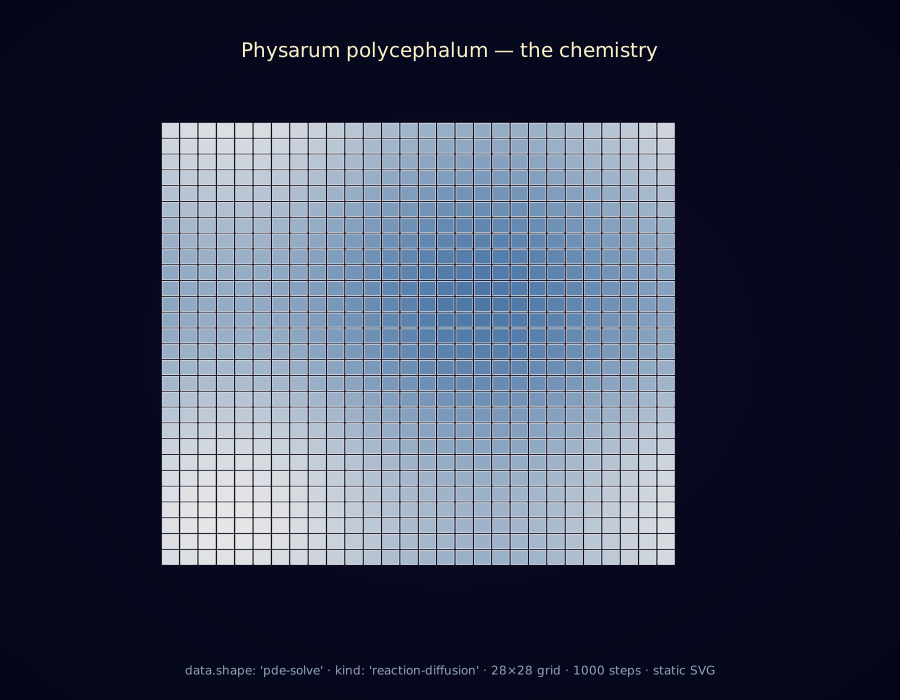
Gray-Scott reaction-diffusion pattern computed by Glyph from a JSON spec. A 28×28 grid showing the developing labyrinthine pattern of U/V concentration, dark blue where U dominates, lighter where V dominates.

The Glyph piece SVG · deterministic

One pde-solve data shape. 28×28 grid. Gray-Scott with F=0.025, k=0.056 — labyrinth regime. 1000 steps. Heatmap layer over the U-concentration field. Byte-identical across CI runs.

The original Physarum-fluid demo WebGL · real-time

The same equation, but coupled with an advected slime-particle population, run on the GPU at 60 fps with mouse interaction. Millions of particles deposit chemicals, the field diffuses + reacts, the particles re-orient toward the gradient.

  • Glyph has the chemistry, not the particles or the loop
  • To match the demo you'd need WebGL output + ping-pong textures
Particle field

Particle field — the physics, frozen

Original: particle-love.com — real-time WebGL particle systems, millions of particles, additive blending, motion blur, mouse interaction.

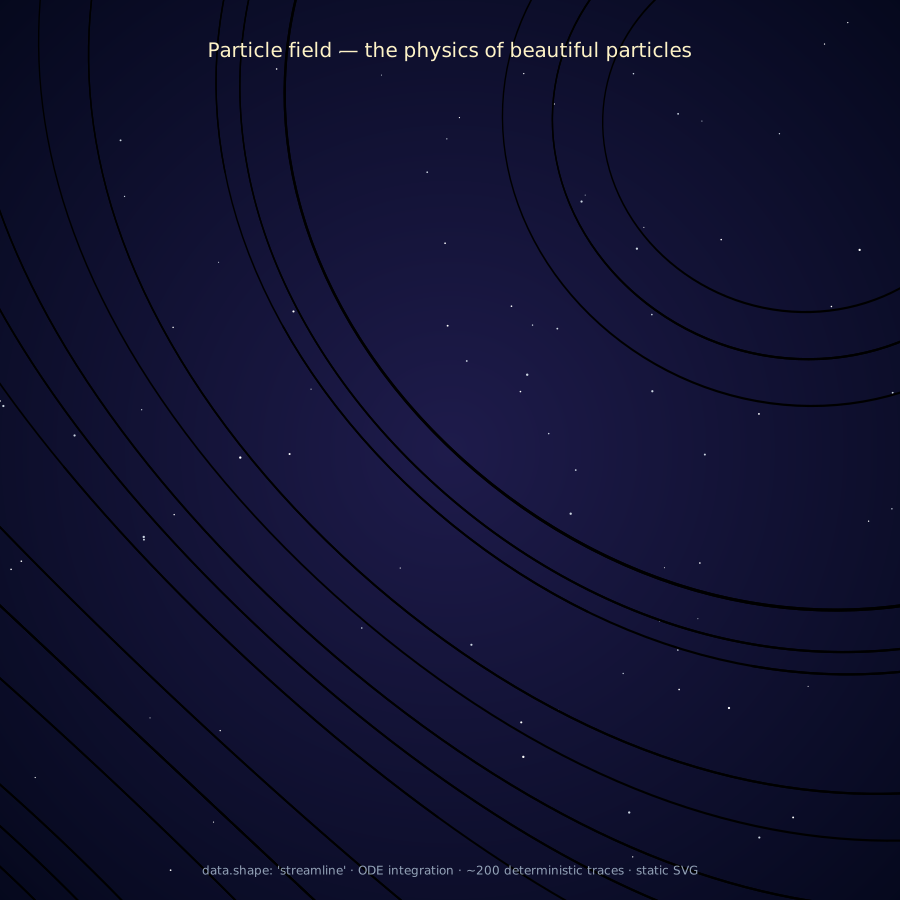
Particle-love's signature look is a million particles tracing the streamlines of a vector field. Glyph's data.shape: "streamline" integrates the same vector field from a grid of seed points using RK4 and renders each trajectory as a colored path. 64 trajectories, not a million — but the same physics, drawn deterministically.

Streamline visualization computed by Glyph from a JSON spec. Two counter-rotating Gaussian vortices. 64 trajectories spiral inward to or outward from the vortex centers, each path colored by the local flow angle.

The Glyph piece SVG · deterministic

One streamline data shape with a double-vortex vector field. 8×8 seed grid → 64 RK4-integrated trajectories. colorBy: angle tints each segment by the local flow direction. The signature visual of a million-particle GPU demo, drawn from the underlying physics alone.

The particle-love demo WebGL · real-time

Millions of particles advected by the same kind of vector field at 60 fps. Additive blending creates the soft-glow trails; motion blur smears the path across frames. Mouse drag injects force.

  • Glyph has the trajectories, not the additive blending or the loop
  • To match, you'd need a particle renderer with additive shaders
Solar system

Solar system — top-down, animated

Original: eyes.nasa.gov · Solar System — full 3D rendering, JPL Horizons ephemeris, planet textures, spacecraft models, time scrubbing, orbital camera.

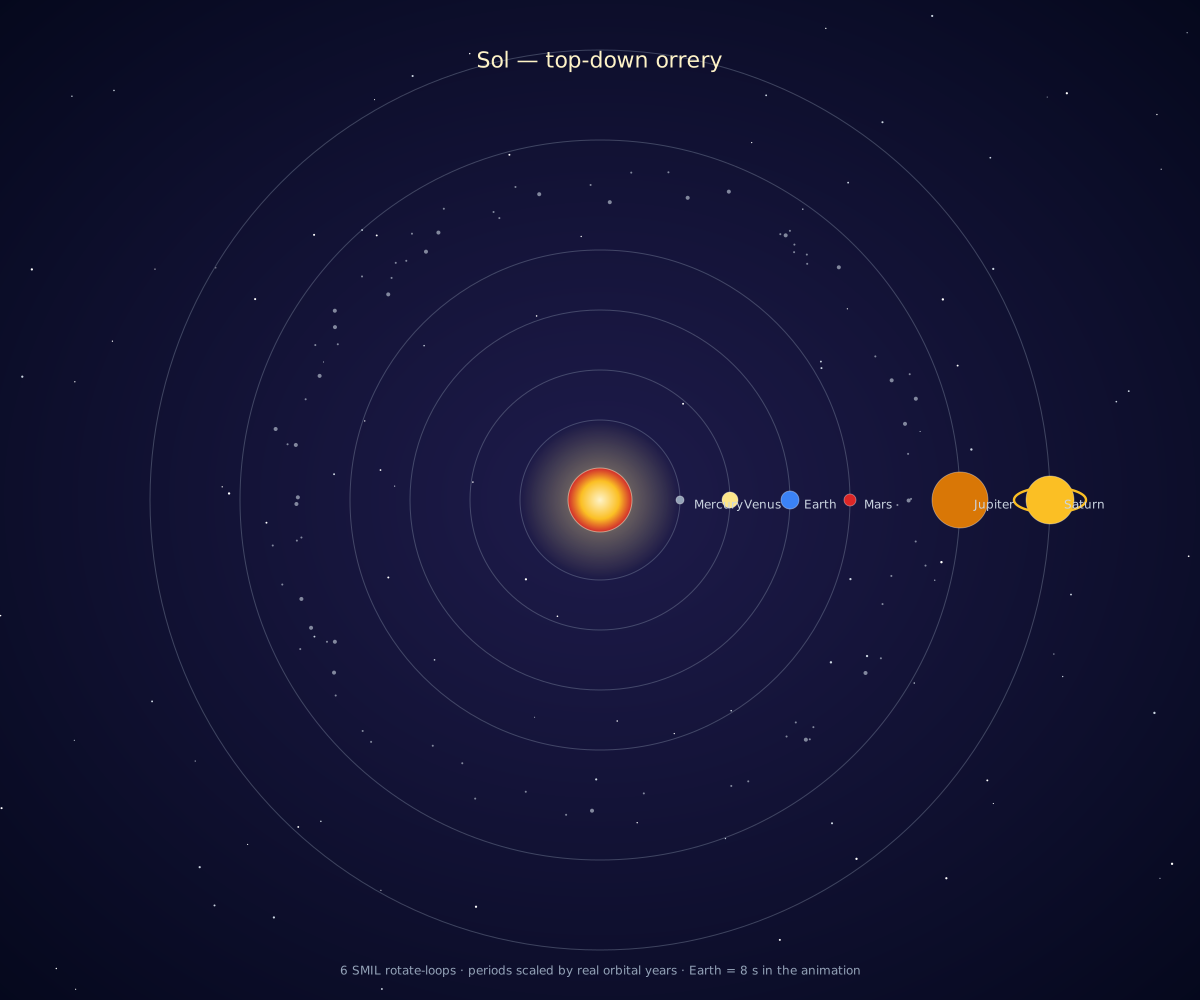
What NASA Eyes does in 3D, Glyph does as a flat orrery — the same instrument 17th-century clockmakers used to teach planetary motion. Concentric orbits + planet circles + a SMIL rotate-loop on each planet with periodMs scaled by the real orbital year. Mercury whips around in ~1.9 seconds; Saturn takes nearly 4 minutes.

A top-down orrery of the solar system rendered by Glyph. Six planets (Mercury, Venus, Earth, Mars, Jupiter, Saturn) on concentric orbital ellipses centered on a glowing yellow Sun. Asteroid belt between Mars and Jupiter shown as scattered dots. Saturn has a co-rotating ring. Deep blue starfield background.

The Glyph piece SVG · animated

Pure compose grammar — no data.shape. 6 planet bodies + Saturn rings, each a silhouette-path with its own rotate-loop animation. Periods scaled so Earth = 8 s. Asteroid belt is 80 deterministically-placed dots in a ring (seed 33).

NASA Eyes Solar System WebGL · interactive 3D

True 3D Three.js scene with JPL Horizons ephemeris feeding planet positions at any date. Camera orbits, zooms, and follows objects. Planet textures from real telescopic imagery. Spacecraft 3D models. Time scrub from -3000 BCE to 3000 CE.

  • Glyph has the orbital topology, not the 3D + ephemeris + camera
  • To match, you'd need WebGL + a 3D camera + ephemeris ingest
ISS engineering schematic

The International Space Station — elevation, side view

Inspiration: NASA's official ISS 3D models — interactive walk-around, real-time TLE-fed orbital position, sunlight + Earth-shine lighting.

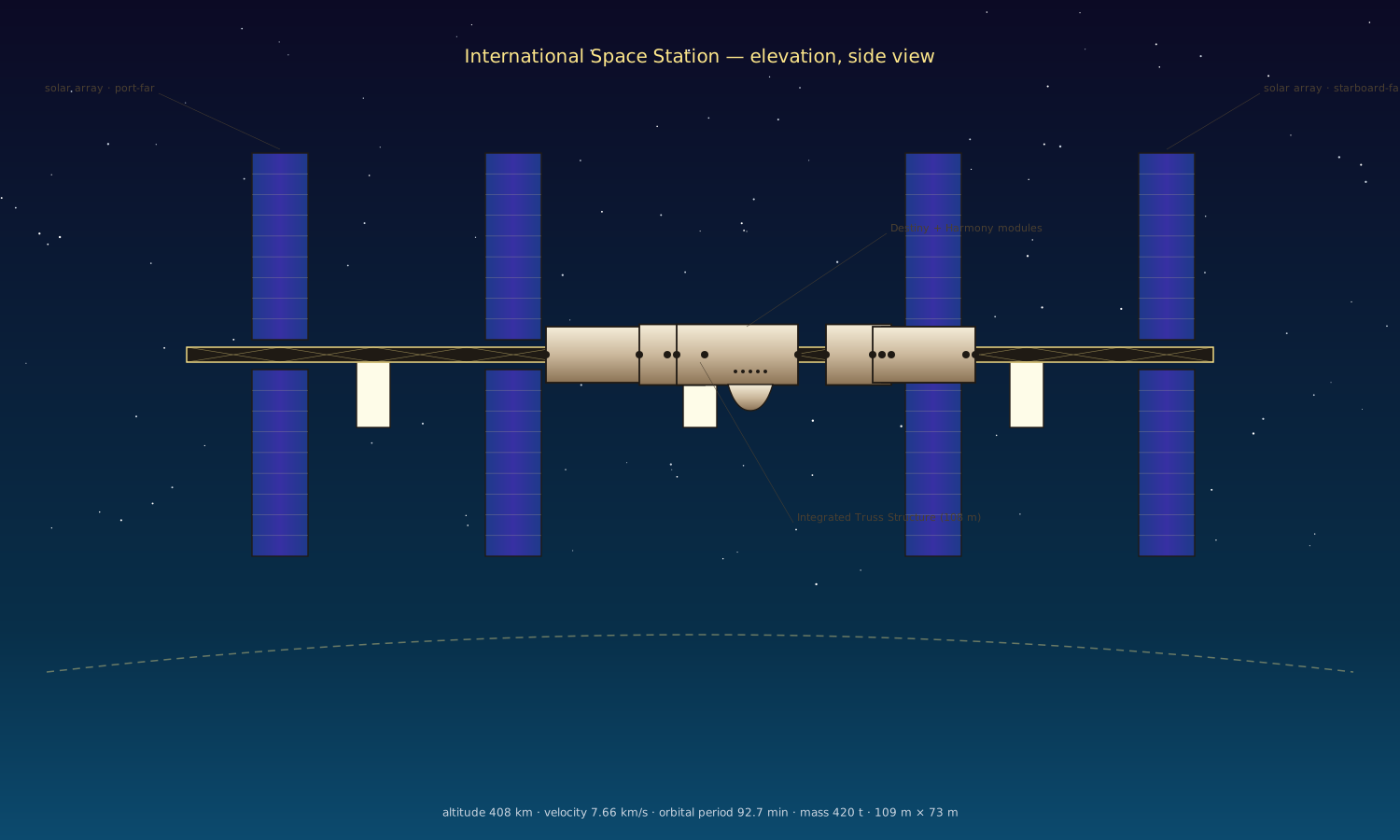
The ISS is too useful as an engineering drawing to skip. Glyph renders it as a pencil-on-parchment side elevation — the same kind of drawing the engineers at Boeing, Roscosmos, JAXA, and ESA shipped to the assembly crew. Truss + solar arrays + modules + radiators + Cupola, all labeled, all to scale.

Side-elevation engineering schematic of the International Space Station. Horizontal Integrated Truss Structure as the spine, 8 solar arrays (4 pairs) extending up and down with photovoltaic cell grid lines visible, 6 pressurized modules in cream along the central axis with docking-port dots on each end, a small Cupola dome below the central modules with 5 window dots, 3 white radiator panels perpendicular to the truss. Annotation labels for the solar arrays, truss, and Destiny/Harmony modules. Starfield in dark space, Earth's curved limb arcing across the bottom in blue.

The Glyph piece SVG · deterministic

Pure compose grammar. Truss as a long silhouette with X-bracing. 8 solar arrays as pattern-detailed rectangles with grid lines. 6 modules + Cupola as silhouette paths with docking ports. 3 radiators. 4 annotation-leaders. Earth limb as a giant arc + atmospheric glow band.

NASA's interactive ISS 3D WebGL · real-time

Full 3D model with textures, orbital lighting (sunward face lit, anti-sunward in Earth-shine), live TLE-fed ground track, walk-around camera. Same hardware, very different rendering.

  • Glyph has the schematic, not the 3D walk-around
  • The engineering elevation IS more useful than 3D for understanding the structure